Why Sunsets Are More Colorful After Rain: A Simple Weather Explainer
Rain rarely leaves a sky neutral. It leaves it scrubbed, heavy with moisture, and full of edges—the dark underside of a departing cloud, a bright seam at the horizon, puddles holding the last light. That is why the sunset after a shower can look almost oversaturated compared with a dry, hazy evening. The effect is not one thing. It is a brief agreement between clearing clouds, low sun, humid air, and whatever particles remain.
You do not need a meteorology degree to read it. You need to know what to look for, and when to be outside.
The Short Answer: Clearing Skies Meet Low Sun
Most of the drama comes from timing. A rain-bearing front usually has a trailing edge, and that edge often arrives late in the day. Behind it, the cloud deck breaks into gaps. If one of those gaps sits near the western horizon at sunset, direct sunlight can slip underneath the cloud cover and travel a long distance through the atmosphere.
That long path matters. When the sun is low, its light passes through far more air than it does at noon. Air molecules scatter short blue wavelengths out of the direct beam, leaving oranges and reds to reach your eye. The cleaner the path and the lower the sun, the more separated those colors can look. This is also why the color is strongest near the horizon and why a few minutes can change everything: the sun is moving through its lowest, thickest slice of atmosphere.
After rain, two things often improve the stage: the air near the horizon may be clearer of coarse dust, and the cloud deck may break into shapes that catch the light. Add wet ground, which reflects color upward, and the whole scene can feel more saturated than it did before the storm.
None of this guarantees a show. A sunset is a temporary alignment, not a setting on a dial. But when the alignment happens, the result can be remarkable.
What Rain Actually Changes in the Air
Rain is a surprisingly selective cleaner. It pulls down larger dust, pollen, and smoke particles, the kind that can make a sunset look milky or washed out. It does not empty the air. It rearranges it.
- Coarse particles drop out. Dust and pollen are heavy enough to be captured by falling drops or washed to the ground.
- Fine aerosols remain. Smaller particles can stay suspended, and some may even become more visible as humidity changes their size.
- Humidity climbs. After rain, the air near the ground and along the horizon is often close to saturation.
- Surfaces turn reflective. Wet roads, puddles, and leaves bounce light back into the scene.
- Cloud structure changes. The storm leaves behind edges, gaps, and dark undersides that create contrast.
The practical point is that “cleaner air” is not automatically “better color.” A very clean sky can give you a pure, pale yellow-orange near the horizon. A sky with the right amount of fine haze can give you a broader, deeper glow. The interesting sunsets usually sit between those extremes.
Why “cleaner air” is not always “better color”
If rain removes too much of the material that scatters light, the sunset can look simple rather than layered. If it leaves too much, the horizon turns into a gray-brown smear. The sweet spot is air that is clear enough to let the low sun through, but textured enough to spread color across the sky. Think of it as a balance between a window and a screen. You need the window to see the light, but a little screen helps the light bloom.
This is why two evenings after similar showers can look completely different. One may have a sharp, narrow band of gold at the horizon and little else. Another may have peach light climbing into broken clouds for twenty minutes. The difference is often not the rain itself but what the rain leaves behind in the air and how the clouds are arranged when the sun reaches the horizon.
Why Humid Air Can Deepen the Palette
Water vapor itself does not paint the sky red. Its effect is more indirect, and more interesting. High humidity changes the size and behavior of the particles that remain. Fine aerosols can absorb water and swell. Swollen particles scatter more light, which can broaden the sun’s glow, soften its edge, and make the whole western sky radiate instead of just a narrow band at the horizon.
Humid haze also acts like a diffuser. It can turn a hard orange disc into a wide amber wash and let pink light climb higher into the clouds than it would on a dry evening. That is one reason the afterglow following a storm can last longer than expected: the light is being scattered through a shallow, moist layer near the horizon.
There is a limit. Very heavy humidity, especially with lingering haze, can flatten contrast and mute the reds. The sky becomes bright but not deep. The difference between a vivid post-rain sunset and a dull one often comes down to how much haze sits in the line of sight and whether the cloud gaps are in the right place. A dry desert sunset can be a clean band of gold; a humid evening after a thunderstorm can turn the whole west into a peach-colored sheet. Neither is better. They are different instruments playing the same light.
The Cloud Break Is the Real Headline
Clouds are both the canvas and the shutter. The ideal setup is not a perfectly clear sky. It is a clean gap near the western horizon, with broken middle or high clouds above it. The gap lets low sunlight in; the clouds give that light something to catch.
Watch the back edge of the storm
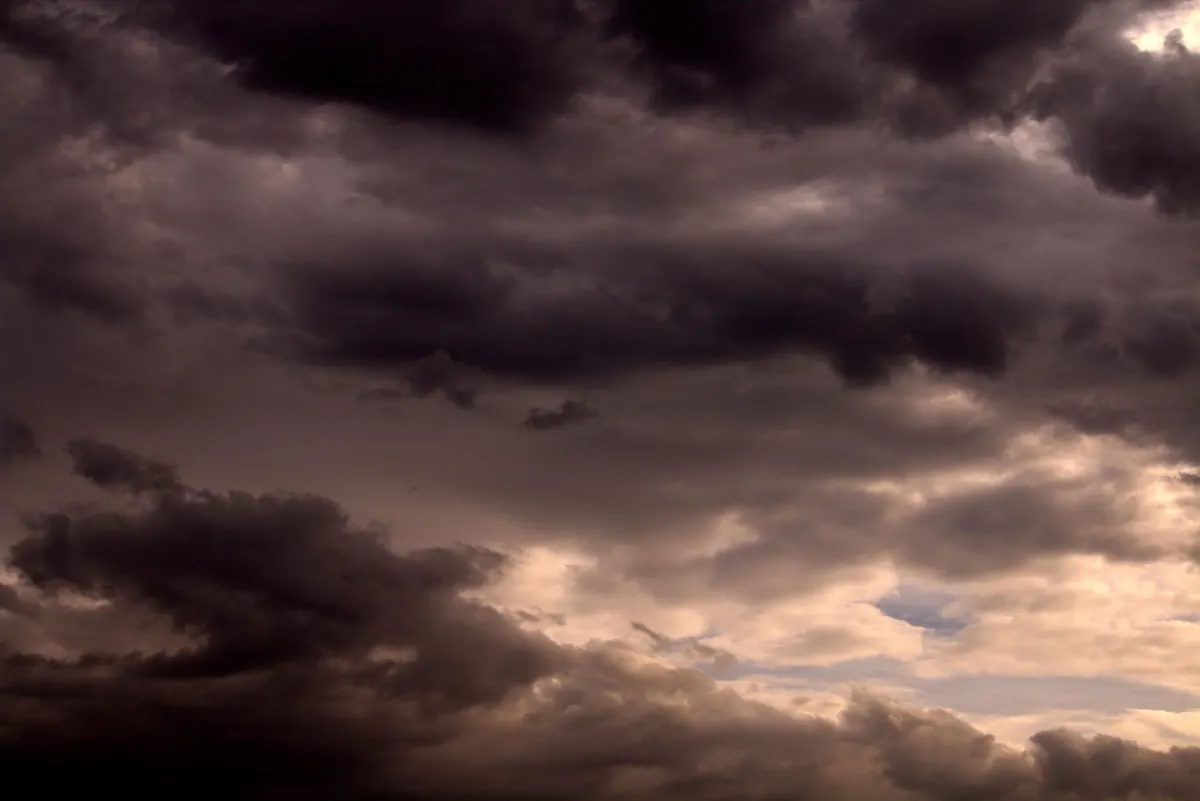
After a cold front or a line of showers passes, the trailing edge often produces the best window. You want the sun to be visible, or nearly visible, under a dark ceiling. If the entire sky is uniformly gray, the light has nothing to catch, and the sunset stays flat. But if the cloud deck has a ragged edge and a strip of clear air beneath it, the scene can light up quickly.
Look for what storm watchers sometimes call a “sunshine alley”: a narrow clear channel under the cloud base. When the sun drops into that channel, it can illuminate the underside of the remaining clouds from below. The effect is brief and local. A neighbor a few miles away may see only gray, while you get a shelf of orange cloud and a bright seam at the horizon. This is why post-rain sunsets can feel like a private event. They are.
The best post-rain sunset is not the clearest sky; it is the most cooperative one.
Why Wet Ground and Puddles Matter
It is easy to focus on the sky and forget the surface. After a shower, the ground is part of the optical system. Wet asphalt, shallow puddles, and rain-slicked leaves reflect the warm light that reaches them. That reflection does not create new color, but it extends the scene. The sunset appears in the sky and again at your feet.
Puddles can also act like small mirrors that catch cloud edges and send them back at a different angle. On a still evening after a storm, a road can become a second horizon. This is one reason photographs taken after rain often look richer than the scene felt in person: the camera is picking up light bouncing from surfaces the eye tends to ignore.
The effect is strongest when the sun is low and the puddles are shallow and calm. A rough, windy surface breaks the reflection into glitter. A deep puddle absorbs more and reflects less. The useful puddles are the thin, flat ones that hold a clean image of the sky.
How to Time Your Evening After a Shower
If you want to improve your odds of seeing a strong post-rain sunset, treat it like a short window rather than a whole evening. The best light often arrives in stages, and the most dramatic color can last only a few minutes.
- Watch the western horizon. Look for the trailing edge of the cloud deck, not just the gray overhead. A break near the horizon is more important than blue sky straight above you.
- Go out before the sun reaches the horizon. The pre-sunset glow can be better than the moment of sunset, especially if high clouds are catching light from below.
- Stay for the afterglow. Some of the deepest pinks and purples appear five to fifteen minutes after the sun disappears, when the light is no longer direct but still illuminating the upper clouds.
- Turn around. The eastern sky sometimes carries the best color because it is reflecting the light from the west. A rainbow or a pink cloud bank opposite the sun is part of the same event.
- Give it a few minutes. A gray gap can close or open quickly. The difference between a dull sky and a vivid one may be one small cloud moving out of the way.
It also helps to know why some post-rain sunsets fail. Sometimes the clearing arrives too late, after the sun has already dropped below the thickest part of the atmosphere. Sometimes the horizon stays socked in with low cloud, so the direct beam never reaches the underside of the deck. And sometimes the air is simply too hazy, turning what could have been a sharp red into a muddy brown. A good sunset needs several things to go right at once: a low sun, a clear path, a cloud to catch the light, and air that scatters without smothering.
That is the real lesson of the after-rain sunset. It is not a reward for the storm. It is a coincidence of geometry, moisture, and timing—brief, local, and easy to miss if you are not looking. But when the clouds break at the right moment, the sky can seem to hold more color than it should, as if the rain has left it with something extra to spend.
Photo: Landiva Weber / Pexels